

Japanese Temari Association
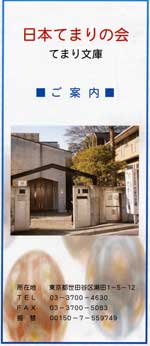 The publication of 12 Months of Temari, a book written and published in 1968 by the Honorary JTA President, Ozaki Chiyoko, was received very positively by temari fans throughout the nation of Japan. The Japan Temari Association was established in 1979 with headquarters and a museum which are presently located in the Setagaya-ku neighborhood of Tokyo. It's purpose is to pass on the art and tradition of Japanese temari, to heighten its artistry, and to educate the successors of temari-making. At the same time, members try to deepen their understanding of the art of temari as well as to aid in cultural exchange with other nations and to help improve Japanese culture.
Click on this link to see the brochure full size.
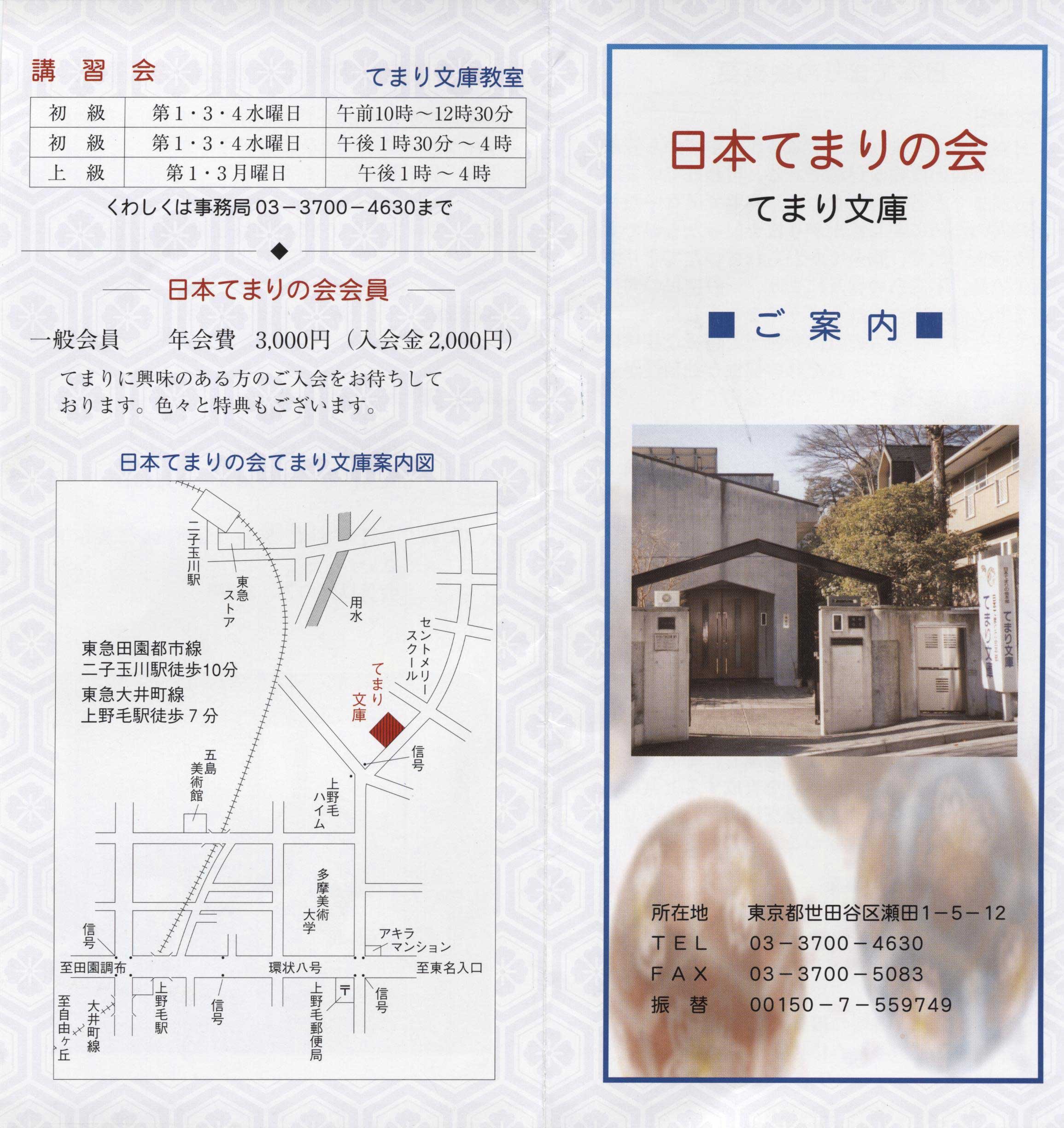
Tasks of Japanese Temari Association
- Opening a gallery to the public
- Hosting classes, seminars, meetings
- Cultural exchange with foreign countries and volunteer activities
- Technique examinations for certification
- Release of newsletters, editing, and publications
Barbara Suess joined the JTA in 2007 and passed certification to teach for them in 2010 (Shihan, Level 3). In 2011, she traveled to Japan with colleagues and participated in classes with three different temari masters. In January of 2015, the JTA introduced a curriculum for international study of the craft that is based on the same one taught in Japan by JTA certified teachers. This exciting opportunity inspired Barbara to begin teaching this same curriculum in her online classes. While these classes can lead to application for certification by Barbara's students, many participate just for the pleasure of learning to make temari with patterns provided by the JTA masters. You do not have to join the JTA or apply for certification when you participate in the JTA curriculum courses.
Technique examinations are divided into four different levels:
Level 1 Honka Shuuryou (Basic course)
Good execution of stitching is the important thing about this level. You can apply for this level after one year of temari study, having successfully mastered techniques learned in Barbara's Level 1 course. By this time, you will have completed 20 - 30 temari. You can apply for levels 1 and 2 at the same time. When applying for Level 1 you submit one photo of superior quality for each:
- Simple 4 division temari, stitched in shikaku kagari (stitching squares)
- Simple 6 division temari, stitched in mitsubane-kikkou kagari (tri-wing or trefoil)
- Simple 8 division temari, stitched in jyouge douji kagari (merry-go-round)
- Simple 12 division temari stitched in uwagake chidori kagari (kiku herringbone)
Level 2 Koutouka Shuuryou (Higher course)
For Level 2, excellent stitching quality is important as well as being able to communicate to someone else how you stitched the temari in your pattern. You should have completed 40 -50 temari before applying for L2. Using current JTA vocabulary is very important not only for the judges but for our translator. These do not have to be your original work so only your technical proficiency is judged, not design. You can learn the many skills for making these more advanced temari and learn how to write patterns using JTA vocabulary and style in Barbara's Level 2 course. Learning to write patterns is also very important in keeping a notebook of your stitching, with directions, diagrams, and photographs. When applying for Level 2, you submit photos of superior quality and written directions with diagrams for:
- Three combination 8 temari
- Three combination 10 temari
Level 3 Shihanka Nintei (Teacher course)
This is one of the most challenging levels and may be applied for two years after receiving Level 2 certification. You need to design eight original temari and write the patterns. Since upon successful completion, the JTA will certify you as a teacher, you should submit temari that demonstrate a wide range of divisions, markings, and stitching techniques, with intricate and more challenging designs. Three of the temari you make are mailed to the JTA for them to keep and use as examples and for sale to support the organization. Or you can request to have them mailed back to you. Barbara is not teaching a course for this at the present time but is happy to work with you during your application period.
Level 4 Kyoujyu Nintei (Master course)
Six original temari and patterns should be submitted for the JTA to keep. All work needs to be of superior quality. You can apply for this level three years after receiving level 3 certification. When you apply for this level, you work directly with the head of Chidori Temari group (for international students).
Information about my courses for learning temari following the JTA curriculum